Showing posts with label predictive analytics. Show all posts

Wednesday, January 22, 2014

My Predictions for the 2014 Analytics Hiring Market


Thanks in part to the media coverage of Big Data, analytics has become inescapable. To those who have worked in and around this industry for years this information is nothing new - merely more visible. Every day I’m hearing about more and more businesses warming to the idea that there are actionable insights readily available in their data if they know how to use it.

It is an exciting time to be a statistician, data scientist, or analytics professional, and if you thought 2013 was big, 2014 promises to be even bigger. Without further ado, here are my top predictions for the analytics hiring market:

1.)  Real-time analytics becomes increasingly important to business intelligence – Industries like the gaming industry already give their customers incentives in real-time and retailers are quickly moving toward real-time couponing. Those of you with real-time data experience will be in high-demand for these growing roles.

2.) Data scientists will be embedded in analytics groups – In addition to analysts who can build complex models, there will be an increasing need for data scientists, who with their background in analytics and computer science can wrangle massive, unstructured data sets. Companies hoping to extract the full benefit from their data sets will need a combination of both groups.

3.) If you don’t have digital you will be a dinosaur! - If your skill set doesn’t already include digital analytics your career plan should be to get experience and soon. Without it your skills will become outdated and obsolete.

4.) Sentiment analysis will continue to erode traditional survey methods – Use of social media data and other “free sources” has the opportunity to overtake traditional survey methods, which will impact the marketing research talent landscape.

5.)  Corporations will bring on internal staff to replace high paid consultants- Consultants got the ball rolling, and now companies will seek to take on full time staff.

6.) However, this will not adversely affect the consulting industry – Demand is so high for analytics experts (and continuing to grow) that there will still be companies looking to small and large consulting firms. Despite some companies hiring full time staff, the consulting industry will continue to experience growth. Heavy travel schedules will continue to be the norm for these opportunities.

7.) The trend towards wearables and PEDs will create new positions- If the buzz from CES2014 is to be believed, the wearables trend is increasing. As with any new technology that creates massive amounts of data, analytics positions will be created in the industry to make sense of and capitalize on all that information.

8.) Startups’ grip on the hiring market will loosen- I have spoken with candidates who have worked with many failed startups, and I think that this year the tendency towards hopping from failed startup to failed startup will begin to shake out. Candidates who have been through the failed startup cycle will begin to realize that to build a career it will be important to learn from an established group.

9.) Graduates from the new analytics programs will begin to hit the job market - This is not so much a prediction as it is inevitable, and I am very interested to see how well these new programs have prepared their students to enter the quantitative workforce.

What trends do you think we will see in the analytics hiring market? Let me know what you think in the comments below.


Thursday, December 19, 2013

Burtch Works' Most Popular Social Media Posts from 2013

2013 was a busy year for Burtch Works’ social media accounts, and I wanted to take the time to revisit some of our most popular links this year. 

Our top links include blog posts on topics from resume writing to data science wannabes, as well as links to our original research, including salary studies and a flash survey of our network. 

Here is our social media year in review:

1.) The consulting trend is really gathering steam but the opportunity is not for everyone, which I addressed in Should You Take That Consulting Role? Here's Why or Why Not.

2.) With networking being more important than ever and holiday parties around the corner these 18 easy conversation starters from Careerealism that I posted were perfectly timed.

3.) Apparently everyone is thinking about retooling their resume, because my latest blog post Need to Rewrite Your Resume? Four Tips Before You Submit is one of the most popular posts on our social media this year.

4.) Are you a real data scientist? Or just a Data Wannabe?


5.) McKinsey put out an informative infographic on Big Data and ROI Big Data Big Profits.

6.) Lou Adler once again published a great article on LinkedIn with 5 Things You Must Not Do In an Interview, and 5 Things You Must.

7.) The Burtch Works Study: Salaries of Big Data Professionals was released in July, and Silicon Angle ran a story about lucrative salaries for foreign-born analysts.

8.) Our Marketing Research Salary Study was released in October, both salary studies and their webinar presentations are available here.

9.) Back in April I addressed the lack of urgency to hire in Help Wanted But Hiring Slow.

10.) While catching up on TEDxTalks in September I watched Big Data, Small World by Dr Kirk Borne which is definitely worth your time. He also maintains a very active twitter presence and was voted the #1 influencer on Big Data by Onalytica.

11.) In a guest post on my blog at the beginning of November, Burtch Works’ entry-level recruiting specialists shared their advice in How to Get Your First Analytics Job.

12.) Researchers at the University of Pennsylvania analyzed social media Big Data to create word clouds showing commonalities by age, gender & personality. Fascinating stuff!

13.) Forbes published my article Five Ways Marketers Can Keep Quants From Quitting in December.

14.) We tallied results from our Flash Survey for analytics professionals about how many are approached via LinkedIn about new job opportunities and how often.

15.) What Design Thinking Can Teach Analytics Professionals was an attention-grabbing article from Data Informed.

With all the attention focused on Big Data, I expect next year to be even busier as more companies look beyond the buzzword and start seeing returns on their investments. The analytics hiring market will continue to heat up, so keep an eye out for my 2014 hiring predictions blog in the beginning of January. For more career advice, blog posts and industry news throughout the year be sure to follow Burtch Works on LinkedIn and Twitter. Happy Holidays everyone!

Friday, February 8, 2013

Predictive Analytics Gender Breakdown

A few weeks ago I examined the demographics of the predictive analytics market in regards to citizenship status. I found that as professionals progress in their careers, the number of workers on visas drops off significantly.

Visa status isn’t the only difference in junior and senior candidates. As I evaluate my internal database of over 7,000 predictive analytics candidates, I noticed that the number of women in quantitative professions decrease noticeably at around the 15 year mark.  


To give you a better idea of what the numbers look in candidates with less experience, here’s a breakdown of entry to mid-level candidates: 

The number of women in predictive analytics, and in the math and science fields in general, has always been much lower compared to men. Based on these data, we learn that life events such as starting a family may be a huge contributing factor in the drop off in women with more than 15 years of experience. 

I will be sure to follow up with more interesting statistics about statisticians in the coming weeks and months, so look out for additional insights into the analytics market.  

Monday, January 28, 2013

Visa Statistics for Predictive Analytics

Last year, as the Big Data craze was starting to make its way into the headlines of every paper in the country, my candidates were approaching me and asking about their options. What’s the hottest industry for Big Data jobs? What cities are hiring quantitative professionals? Today, the demand for these workers is higher than ever and the ball is in the company’s court to fill the need.    

As a recruiter for predictive analytics jobs, I am in the unique position to follow trends in candidate demographics and client hiring practices. Recently, many clients have asked for data on visa statistics for analytic professionals, so I examined how many companies are willing to transfer visas and then compared this to the number of candidates on H-1Bs. 

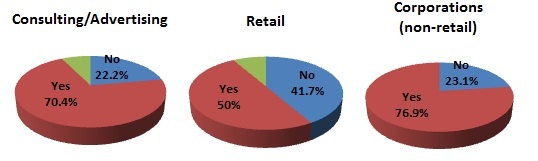
In evaluating the transfer policies of over 50 companies, I found that over a quarter will not transfer H-1Bs.  


Number of Companies Willing to Transfer H-1B Visas:


Detail by Industry:


The analytic talent war is in full swing, and as a hiring authority, if you are not willing to transfer an H-1B, you are missing out on a substantial pool of highly qualified candidates. In a sample of over 7,000 quantitative professionals in our network with varying levels of experience, I found the following: 


Visa Status of Entry-Mid Level Candidates:


As the data clearly show, when recruiting for entry to mid level positions, companies are doing themselves a great disservice by hesitating to transfer H-1B visas. Because more seasoned workers eventually progress to a green card or citizenship, this is less of an issue with senior level professionals.   


Visa Status of Mid-Senior Level Candidates:


Overall, transferring an H-1B visa is a fairly straightforward process that will open the door to a significant number of viable candidates. To be sure, visa situations do require extra legal attention but when handled properly, it is an investment that more companies ought to be making.

Stay tuned in the coming weeks for a follow up on frequently asked questions regarding visa transfers, as well as more helpful information on the predictive analytics talent pool. As I delve deeper into the demographics of my candidate database, I am finding more insight into what companies can expect when making hiring decisions and how this impacts the Big Data job market.